
Threshold settings help optimize the performance of your HVAC system, enhancing both comfort and energy efficiency. You can adjust them either directly from your thermostat or using the Cielo Home App.
⚠️ Caution
- Be cautious while modifying these settings, as it may affect the performance of your equipment.
Changing Threshold Setting on Cielo Smart Thermostat
Step 1: Go to 'Menu' and select 'HVAC Settings'.
Step 2: Select ‘Threshold Settings’.
Step 3: You can choose from the premade threshold template:
- Energy Saver
These threshold values are carefully designed to ensure maximum energy savings. By applying the Energy Saver, you can optimize energy usage for the best possible savings.
- Optimal
These threshold values are designed to help you strike a balance between optimal home climate and energy savings. Using these pre-defined thresholds, you can achieve a perfect balance between optimized home comfort and lower energy bills.
- Comfort
These thresholds are meticulously set to maximize your comfort level. By applying these tailor settings, you can optimize your environment to achieve maximum comfort throughout.
- Advanced
These thresholds are for advanced customization, allowing you to tailor your home climate for greater control. You can fine-tune your environment to your preferences, ensuring a personalized experience with complete control.
Note: The advanced threshold settings will differ based on your configured equipment.
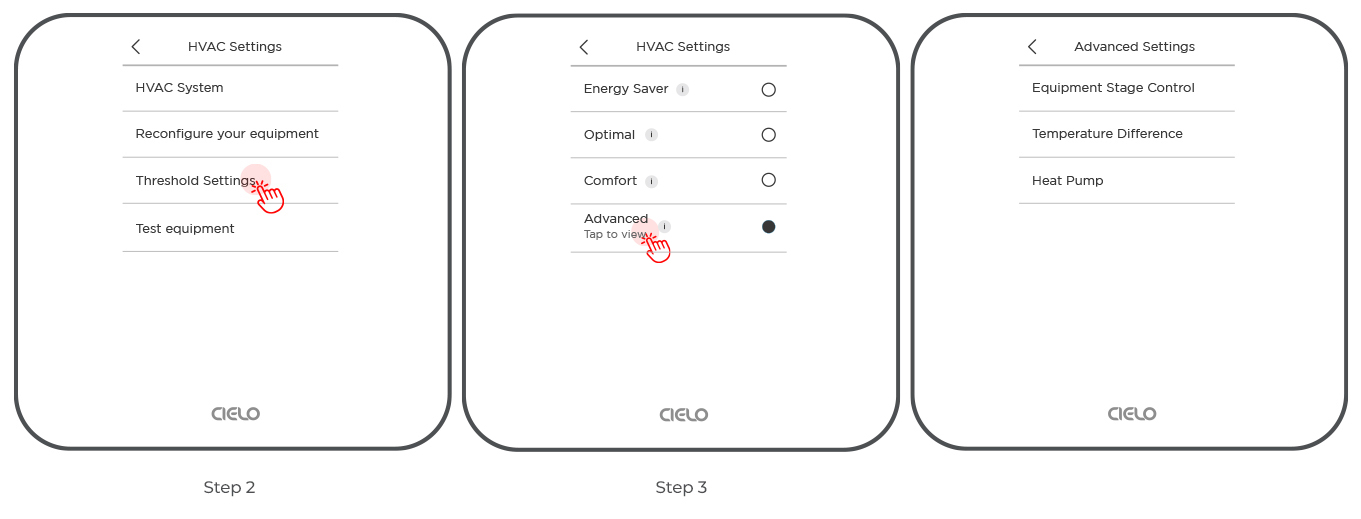 Advanced Threshold Settings
Equipment Stage Control
- Gradually turns off the heating or cooling stages as the home temperature approaches the setpoint.
- Available only if your equipment has more than one heating or cooling stage. Enabling this option saves you energy.
Temperature Difference
- Set the minimum temperature difference that the Cielo Smart Thermostat will take into account before engaging in heating and cooling.
Heat Pump
Temperature Difference - Stage 2
This is the temperature difference between the indoor and the setpoint before engaging stage 2. Use up and down arrows to adjust the difference.
Minimum Outdoor Temperature
This is the lowest outdoor temperature below which the heat pump will be automatically turned off, and Aux heating (if available) will be used as a heat source.
Use the up and down arrows to set the minimum outdoor temperature. You can also disable this setting. However, it is not advised to keep the system running at a temperature below what it can handle.
Max Runtime Stage 1
Use the up and down arrows to set the maximum number of minutes that stage 1 will run before engaging stage 2 of the compressor.
Minimum Off Time
Use the up and down arrows to set the minimum amount of time the compressor remains off between cycles.
Minimum On Time
Use the up and down arrows to set the minimum amount of time the compressor will stay on. In case the compressor is activated but the call is terminated abruptly, the compressor will run for the set duration before shutting down.
Heat Dissipation Time
This is the time in minutes that the fan of your HVAC system will run after your heating has been turned off. Use up and down arrows to adjust the time.
Cool Dissipation Time
This is the time in minutes that the fan of your HVAC system will run after your cooling has been turned off. Use up and down arrows to adjust the time.
Changing Threshold Settings on the Cielo Home App
Step 1: On the Control Screen, tap on the ‘Settings’ icon at the top right corner.
Step 2: Tap on 'HVAC Settings.'
Step 3: Tap on 'Threshold Settings.'
Step 4: You can choose from the premade threshold templates:
Energy Saver
These threshold values are carefully designed to ensure maximum energy savings. By applying the Energy Saver, you can optimize energy usage for the best possible savings.
Optimal
These threshold values are designed to help you strike a balance between optimal home climate and energy savings. Using these pre-defined thresholds, you can achieve a perfect balance between optimized home comfort and lower energy bills.
Comfort
These thresholds are meticulously set to maximize your comfort level. By applying these tailors settings, you can optimize your environment to achieve maximum comfort throughout.
Advanced
These thresholds are for advanced customization, allowing you to tailor your home climate for greater control. You can fine-tune your environment to your preference, ensuring a personalized experience with the advantage of complete control.
Temperature Difference
Heat Temperature Difference
This is the minimum difference between the heating setpoint and indoor temperature before the heating starts.
For example, if your preferred setpoint is 68°F and your temperature difference is 1°F, the heating will start as soon as the room temperature drops to 67°F.
Cool Temperature Difference
This is the minimum difference between the cooling setpoint and indoor temperature before the cooling starts.
For example, if your preferred cooling setpoint is 70°F, your temperature difference is 1°F, the cooling will start as soon as the room temperature is 71°F.
Equipment Thresholds
This allows you to control how your HVAC system operates.
Note: This will vary depending on your configured system.
Temperature Thresholds
Temperature Difference Stage 2
This is the difference between your indoor and setpoint temperature before stage 2 is activated to help achieve the setpoint. Setting a higher number will result in more savings because stage 2 may not be activated frequently.
In normal weather conditions, HVAC systems can efficiently maintain indoor temperature using stage 1 only and save you energy.
📢 Important
- In normal weather conditions, HVAC systems can efficiently maintain indoor temperature using stage 1 only and save you energy.
- The temperature difference stage 2 is dependent on the set values for Heat/Cool temperature difference and cannot be lower than either of the two values.
Minimum Outdoor Temperature
If the outdoor temperature falls below a minimum threshold, the heat pump will turn off and switch to auxiliary heating. When the outdoor temperature goes above the maximum threshold, auxiliary heating will stop, and the heat pump will start running again.
📢 Important
- Most standard heat pumps are not designed to operate efficiently in extremely low temperatures. In such conditions, continuing to run the heat pump can reduce performance and potentially cause strain on the system. For ideal settings, please refer to the user manual of your heat pump.
- Thermostat installation address is required to fetch the outdoor weather data.
Operational Timers
Maximum Runtime For Stage 1
The maximum runtime for stage 1 is before stage 2 is activated to achieve the temperature setpoint.
Note: If you have enabled Stage Control, this option will not be applicable. You may disable it in the Equipment Stage Control.
Minimum Off Time
The minimum OFF time of the heating or cooling system before the thermostat turns it ON again. (A minimum value of 5 minutes is recommended to prevent the system from short cycling.
Minimum On Time
The minimum ON time of the heating or cooling system before the thermostat turns it OFF again. (A minimum value of 5 minutes is recommended to prevent the system from short cycling.
Heating Dissipation Time
Time for which the fan of your HVAC system will run after the heating has been turned off. This ensures that the hot air left in the ducts is blown into the room to maximize the use of generated heat.
Cooling Dissipation Time
Time for which the fan of your HVAC system will run after the cooling has been turned off. This ensures that any remaining cool air in the ducts is circulated into the room to maximize the efficiency of the cooling cycle.
Equipment Stage Control
Stage Control
ON - Stage 2 of your equipment automatically turns off as your home temperature approaches your setpoint, and Stage 1 can efficiently reach your setpoint on its own.
OFF - Your equipment will keep on running in stage 2 until your setpoint is achieved.
Aux to Heat Pump
ON - Auxiliary heat is automatically turned off as your home temperature approaches the setpoint, while the heat pump operates to attain your desired temperature.
OFF - Auxiliary heat keeps on running until your setpoint is achieved.
Aux Control
ON - Stage 2 of your auxiliary equipment automatically turns off as your home temperature approaches the setpoint, and stage 1 can efficiently reach your setpoint on its own.
OFF - Stage 2 of auxiliary equipment keeps running until your setpoint is achieved.
[[related:19736739515031,34863339040151,29871204411159]]